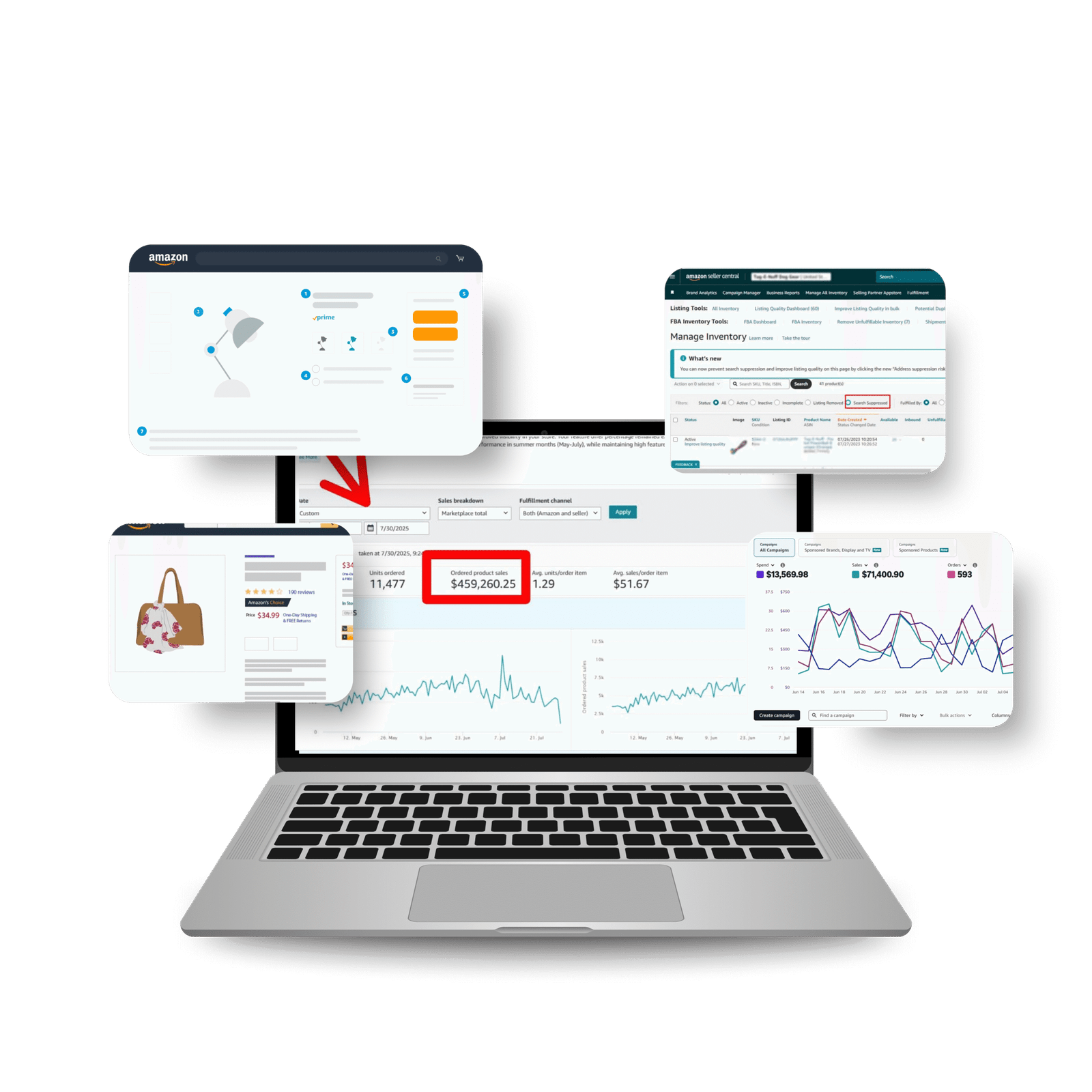
Amazon Account Management That Connects the Whole Business
A rising ad bill may be a campaign problem—or it may point to a weak detail page, an uncompetitive offer, or a product that keeps running out of stock. Amzexact connects catalog, creative, media, and operations so the team fixes the cause, not just the visible symptom.
The work starts at the SKU level: visibility, clicks, conversion, ad cost, fees, and availability. Findings become a ranked plan with clear ownership, then are reviewed against account performance—not a list of completed tasks.

Are These Amazon Growth Problems Holding the Account Back?
Sales Growth Has Stalled
More SKUs and a larger ad budget should not be mistaken for momentum. The first question is where growth stopped: fewer relevant shoppers, weaker conversion, lost availability, an offer that no longer competes, or a product mix that has shifted toward lower-value sales.
Ad Spend Is Outpacing Returns
An attractive advertising sales figure can hide poor economics. Search terms, placements, cost per click, conversion, total sales, and product margin belong in the same review. That shows which campaigns deserve investment and which are simply paying to capture demand the brand already had.
Listings Are Not Converting
Traffic only creates an opportunity; the page still has to earn the order. The team checks whether the main image is clear on mobile, the offer is competitive, the title and bullets answer buying questions, variations make sense, and reviews or returns reveal unresolved objections.
Expansion Lacks a Clear Plan
Before launching another SKU or opening a new channel, the team tests demand against competition, fees, margin, fulfillment, content requirements, and the budget needed to learn. Expansion is strongest when the product and operating model are ready—not just when a channel looks attractive.
Account Execution Is Fragmented
When separate teams own the listing, ad account, creative, and replenishment plan, small delays become expensive. A campaign may keep spending on a suppressed or low-stock ASIN. Connected ownership gives the account one set of priorities and makes the handoffs visible.
One Ecommerce Growth Team Across Every Sales Channel
Marketplace Strategy & Operations
Amazon, Walmart, eBay, Etsy, Shopify, and TikTok Shop do not reward identical merchandising. The team decides where each product belongs, then adapts the offer, catalog data, content, promotions, and media to the channel while keeping brand and commercial goals aligned.
Storefront & Conversion Management
The path from discovery to checkout is only as strong as its weakest step. The team examines search visibility, category placement, product-page clarity, variation structure, price, availability, and purchase friction together, then fixes the issues most likely to affect conversion.
Website Development
An owned website has room to explain the brand, capture demand, and support repeat purchase in ways a marketplace listing cannot. The work focuses on a clean product hierarchy, fast mobile browsing, useful product education, and a checkout path that does not make shoppers work to buy.
Creative & Graphic Design
A strong visual system does more than look polished. The first image earns attention; secondary images show use, scale, and differentiation; A+ and storefront assets build understanding; ad creative brings the right message to the right placement. Every asset has a job.
Connected Marketplace Reporting
A useful report explains movement, not merely totals. Amzexact brings SKU-level sales, traffic, conversion, ad spend, and account issues into one discussion: what changed, why it matters, what the team will do next, and which decisions need client input.
Flexible Support As You Scale
The engagement follows the problem. An audit identifies priorities; a specialist project delivers a defined outcome; ongoing management coordinates recurring decisions across catalog, media, creative, and operations. The scope can expand when the workload genuinely calls for it.
A Look at the Brands Behind the Work
A selection of brands represented in Amzexact’s work. Explore the portfolio for the actual creative and account projects behind these names.
Amazon Services Built Around How Sellers Actually Grow
Amazon growth is a sequence of decisions, not a collection of disconnected services. The team validates the product and offer, prepares the listing and stock, builds discoverability, strengthens conversion, then scales advertising and account operations against the product's economics.

Product Research & Opportunity Validation
Start with a real buying need. Compare search demand, competing offers, review themes, price bands, referral and fulfillment fees, and expected contribution margin. The output is a clearer go/no-go decision and a sharper brief for product positioning.
Launch Planning & Account Setup
Map launch dependencies before the first campaign goes live: account and category requirements, accurate catalog data, a buyable detail page, inventory cover, creative assets, pricing, and an initial test budget. Early media should generate learning as well as sales.
Amazon SEO & Keyword Strategy
Build a search-term map around the ways customers actually describe the product. Apply it to titles, bullets, attributes, and supporting content where relevant, while keeping claims accurate and the page readable for the person deciding whether to buy.
Product Images & A+ Content
Plan the image sequence around the buying decision: identify the product immediately, show scale and use, explain differentiators, and resolve common objections. Where the brand is eligible, A+ Content adds a clearer story without making unsupported claims.
Listing & Conversion Optimization
Look beyond keyword placement. Compare sessions and conversion with price moves, review themes, image changes, availability, and variation behavior. Prioritize the page elements that remove uncertainty and make the offer easier to choose.
Brand Storefront Design
Give shoppers a useful route through the catalog rather than a decorative landing page. Group products by need or use case, make comparisons intuitive, and connect campaign traffic to the most relevant Store destination and detail pages.
Advertising & Promotions
Separate discovery, defense, and conversion goals in the ad structure. Review search terms, targeting, placements, spend, and product-level returns before moving budget. Coupons and seasonal promotions are evaluated against margin and inventory, not just top-line lift.
Full Account Management & Expansion
Own the recurring decisions that make the account work: catalog and suppression checks, stock signals, campaign adjustments, promotion timing, creative priorities, and performance reviews. The client sees what changed, what is next, and where a business decision is needed.
The Right Specialists, Working From One Plan
Specialists matter most when their work is connected. The same product plan should inform the listing, creative brief, ad budget, stock forecast, customer-service response, and management report. That reduces contradictory decisions and gives the client a clearer view of progress.
Full-Service Amazon Management
An account lead connects the commercial plan to weekly execution: which SKUs need attention, what is blocking conversion, where media should move, and which operational issues could interrupt sales.
Product Listing Optimization
Translate shopper intent into a page that answers it. The team reviews search relevance, title and bullets, images, variations, price, and offer quality before deciding which change is most likely to improve conversion.
Graphic Design
Design is built around product understanding: an unmistakable main image, visual proof of features and scale, clear comparison or use-case graphics, and assets suited to each marketplace placement.
Full-Service Walmart Management
Walmart needs its own retail plan. Assortment, item setup, content, availability, pricing, and media are reviewed against Walmart's shopper experience and operating requirements.
eBay, Etsy & Shopify Management
The brand stays recognizable while each storefront gets the right product data, merchandising, promotions, and service workflow. Marketplace conventions and owned-store economics both shape the plan.
TikTok Shop Management
Turn attention into a buyable offer. Product setup, short-form creative, promotion rules, inventory, and fulfillment are coordinated before a TikTok Shop campaign asks viewers to act.
PPC Advertising
Build a campaign structure that separates objectives and products clearly enough to diagnose performance. Search-term, targeting, and placement data guide bid, budget, and negative-targeting decisions.
Amazon SEO
Research the terms that signal purchase intent, map them to the right products, and use relevant language in catalog fields. Search visibility is only valuable when the offer and page can convert the visit.
Customized Reporting
Connect the metric to the decision. Reports show SKU and channel movement, media efficiency, conversion, stock or account issues, actions completed, and the next priority in language a business owner can use.
Demand-Side Platform (DSP)
Define the audience and objective before buying reach. DSP planning ties creative, frequency, placements, and available measurement to the products and customer journeys worth investing in.
Revenue Reclaim
Review relevant transaction and inventory records for potential reimbursement opportunities, document the discrepancy, and follow the marketplace's current claim process.
Customer Service Management
Respond to buyers accurately and on time within each marketplace's rules. Recurring complaints are fed back into product content, fulfillment, packaging, or quality decisions.
Get the Support the Account Actually Needs
One-off projects
Best when the account has a specific bottleneck. Scope, deliverables, owner, and completion criteria are agreed up front—whether the need is a listing rebuild, Brand Store, campaign restructuring, audit, or catalog repair.
Retainer engagement
Best when results depend on repeated decisions. The team works through a recurring review of sales, conversion, media, catalog health, and stock signals, then adjusts the work plan as the account changes.
Dedicated resource
Best when internal capacity is the constraint. A dedicated point of contact keeps priorities, specialist handoffs, reporting, and decisions moving while the client retains visibility and control.
The right model depends on the number of active SKUs, channel complexity, internal capacity, and how much ongoing coordination the account needs.