Report to stakeholders
Give leadership a concise view of movement, priorities and the decisions waiting for them.
Amazon gives you data everywhere. We connect the signals that matter—sales, advertising, conversion, margin and stock—so your team can make clearer decisions, faster.
This published Amazon Ads capture shows campaign performance over a defined period. In Reporting 2.0, the point is to connect a source like this to sales, product economics and account conditions before recommending a move.
See the PPC management page ↗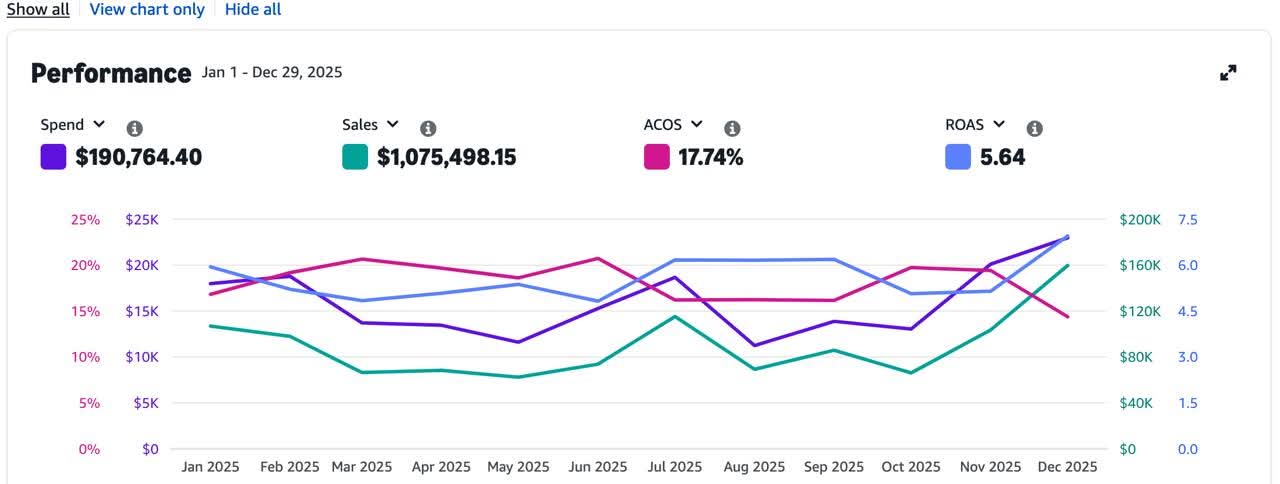
The detail should be there when you need it. The main story should never get buried inside it.
Give leadership a concise view of movement, priorities and the decisions waiting for them.
Read ads, sales, conversion and operational signals together—not as separate wins and problems.
Connect what changed to its likely causes before shifting budget or changing the plan.
Keep a relevant, consistent view instead of asking every stakeholder to interpret a raw export.
A spike or dip rarely explains itself. Our reporting rhythm connects the metric to the product, campaign and account conditions around it.
Start with the meaningful shift, not a wall of metrics.
Look across sales, traffic, conversion, media efficiency and availability. Separate normal variation from a signal worth investigating.
Read the shift at SKU and campaign level. Did demand change, the offer weaken, stock tighten, or spend move to a different product?
Turn findings into a ranked action, a responsible owner and a point to review whether the change worked.
The exact view depends on your business. These are the signals we bring together when the data is available and relevant.
Revenue, units, product mix, fees and contribution context—so growth is not mistaken for profit.
Spend, attributed sales, search terms, placements and efficiency, read alongside total account movement.
Sessions, buyability, detail-page changes and shopper signals that help explain whether visits become orders.
Availability, suppressed listings and other account conditions that can interrupt an otherwise good plan.
A founder may need the big picture. A channel lead may need the SKU detail. A finance lead needs to know whether the economics hold. The same reporting system should serve each conversation.

Keep an eye on changes that may need prompt action, such as stock, spend or listing health.
Compare the recent trend with the work completed, then agree on the next focused actions.
Step back to product economics, channel priorities and the next investment decision.
These existing AMZEXACT studies show different views of performance. Each source and time period should be read on its own terms.

The study separates its sales comparison from the paid-media reporting period.
Read the case study ↗
A dated Seller Central snapshot and a separate ad view give context to a margin-sensitive category.
Read the case study ↗
Product education and advertising are considered together rather than as isolated work.
Read the case study ↗The same six client videos and stories featured on our homepage.
Great Amazon UK account management. Professional, reliable, and very knowledgeable. Communication was excellent and the account was managed smoothly.

Let’s look at what your account already tells us, which questions remain unanswered and where a clearer view could help most.
Request a free account audit ↗