
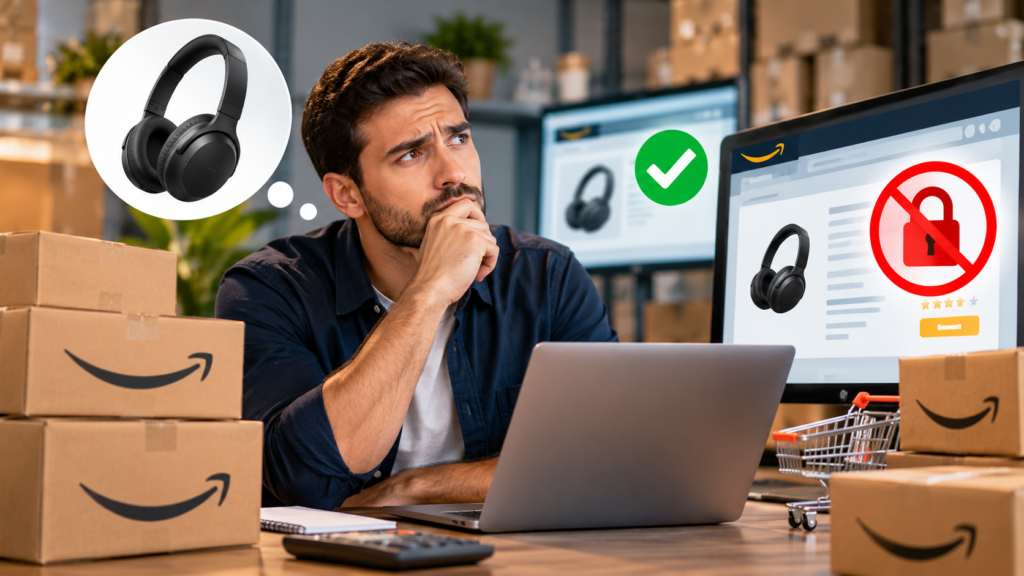
Every day, aspiring entrepreneurs jump into Amazon Seller Central hoping to build a successful eCommerce business. They spend hours researching products, analyzing competitors, negotiating with suppliers, and calculating profit margins.
Then many of them make a costly mistake before they even make their first sale.
They buy inventory first.
And only afterward discover that Amazon won’t allow them to sell the product.
What looked like a profitable opportunity suddenly becomes thousands of dollars tied up in inventory with no clear path to market.
At AMZEXACT, we’ve helped countless sellers avoid this exact situation through our Amazon Consulting Services and Amazon Management Services . The surprising part? Preventing this mistake takes less than five minutes.
The Inventory Mistake That Costs Sellers Thousands
Imagine you’ve found what appears to be the perfect product.
The numbers look fantastic:
- Wholesale cost: $20 per unit
- Quantity ordered: 500 units
- Total investment: $10,000
- Selling price: $39.99
Everything seems profitable.
You place the order.
The inventory arrives.
You log into Amazon Seller Central to create the listing.
Instead of seeing:
“Sell This Product”
You see:
“Apply to Sell”
Or worse:
“Not Available”
Suddenly, your entire business plan changes.
The supplier is legitimate.
The products are authentic.
Demand exists.
But your seller account isn’t approved to sell that specific ASIN, brand, or category.
And now your $10,000 investment is sitting in boxes.
Why Amazon Product Approval Matters More Than Most Sellers Think
Amazon is one of the largest online marketplaces in the world, creating incredible opportunities for sellers.
However, many new sellers assume Amazon is an open marketplace where anyone can sell any product.
That’s simply not true.
Amazon places restrictions on:
- Individual ASINs
- Product categories
- Subcategories
- Brands
- Regulated products
- Certain marketplaces
This means you could be approved to sell one product while being restricted from selling another product in the exact same category.
That’s why experienced sellers don’t ask:
“Can I sell in this category?”
They ask:
“Can my Amazon seller account sell this exact product today?”
This distinction is critical.
Through our Amazon Seller Central Management services, we regularly help brands identify these restrictions before they invest significant capital.
The $10,000 Inventory Trap
Let’s break down a real-world scenario.
A supplier offers a product at $20 per unit.
You order 500 units.
Your total investment:
$10,000
The product currently sells on Amazon for:
$39.99
Projected revenue:
$19,995
The opportunity looks incredible.
But after purchasing inventory, you discover your account cannot list the product.
Now you have:
- Unsold inventory
- Capital tied up
- Storage expenses
- Cash flow issues
The worst part?
The problem could have been discovered before spending a single dollar.
This is why inventory validation should always come before inventory purchasing.
Existing Amazon Listings Don’t Guarantee You Can Sell Them
One of the biggest misconceptions among new sellers is:
“If the product is already on Amazon, I can sell it.”
Unfortunately, that’s not how Amazon works.
Many sellers already have:
- Brand approvals
- Category approvals
- Compliance documentation
- Long-standing account history
Just because another seller can offer a product doesn’t automatically mean your account can.
Before sourcing inventory, it’s important to perform both product research and account eligibility research simultaneously.
This is where professional Amazon SEO and Product Listing Optimization Services can help sellers identify profitable opportunities without running into avoidable restrictions.
Categories That Frequently Require Approval
While restrictions can exist almost anywhere, certain categories commonly require additional approval.
Beauty & Personal Care
Beauty products often require authenticity verification and compliance documentation.
Grocery & Gourmet Foods
Food products involve expiration dates, labeling requirements, storage conditions, and safety regulations.
Health & Wellness
Supplements and health-related products often require extensive compliance checks.
Jewelry
Amazon may require additional documentation to verify authenticity and sourcing.
Watches
Certain brands and products within the watch category frequently require approval.
Clothing & Accessories
Some apparel brands and products may carry additional restrictions despite being widely available on Amazon.
Rather than trying to memorize every restricted category, successful sellers simply verify eligibility for each ASIN before purchasing inventory.
Approval Is Not Always Automatic
Many sellers see the “Apply to Sell” button and assume approval is guaranteed.
That’s not always the case.
Amazon may request:
- Supplier invoices
- Brand authorization letters
- Product certifications
- Compliance documents
- Safety reports
Even if your inventory is 100% authentic, Amazon may still require supporting documentation before granting approval.
This is one reason many sellers work with Amazon Consulting Experts before making large inventory purchases.
Bigger Orders Create Bigger Risks
Wholesale suppliers often reward larger purchases with better pricing.
The temptation is understandable.
If 50 units are profitable, then 500 units should be even better.
But larger orders create larger risks.
Seller A
Orders 25 units.
Investment:
$500
Seller B
Orders 500 units.
Investment:
$10,000
If both sellers discover they cannot sell the product on Amazon, Seller A faces a minor setback.
Seller B faces a major financial problem.
Successful Amazon businesses scale inventory after validation — not before.
Unsold Inventory Costs More Than Most Sellers Realize
Many new sellers focus entirely on potential revenue.
But inventory has carrying costs.
If products remain unsold, you may face:
- Amazon FBA storage fees
- Long-term storage charges
- Inventory removal fees
- Disposal costs
- Lost working capital
Every dollar trapped in unsold inventory is a dollar that can’t be used for growth.
That’s why successful sellers evaluate risk just as carefully as profit potential.
The Correct Order of Operations
Before placing a wholesale order, follow this process:
Step 1
Identify the exact ASIN or product.
Step 2
Search the product inside Amazon Seller Central.
Step 3
Review the selling status.
Look for:
- Sell This Product
- Apply to Sell
- Not Available
Step 4
Check restrictions and limitations.
Step 5
Review documentation requirements.
Step 6
Calculate Amazon fees and costs.
Step 7
Analyze demand and competition.
Step 8
Start with a smaller inventory order.
Step 9
Validate sales performance.
Step 10
Scale inventory once profitability is proven.
This process has helped many sellers avoid expensive inventory mistakes while building sustainable businesses.
Don’t Focus on Revenue Alone
One of the biggest mistakes new Amazon sellers make is confusing revenue with profit.
A product selling for $40 does not automatically generate $20 in profit.
You still need to account for:
- Amazon referral fees
- FBA fulfillment costs
- Storage fees
- Inbound shipping
- Product preparation costs
- Returns
- Software subscriptions
- Advertising expenses
This is where a strong Amazon PPC Management and Amazon SEO Optimization become essential.
The most successful sellers focus on net profit — not revenue.
What If You’ve Already Purchased Restricted Inventory?
\ If you’ve already made this mistake, don’t panic. \ You may still have options:
Apply for Approval
If Amazon offers an approval pathway and you have the required documentation, approval may still be possible.
Return Inventory
Some suppliers may allow returns or exchanges.
Sell Through Other Channels
\ Depending on the product, you may be able to sell through:
- Your own website
- eBay
- Walmart Marketplace
- Local marketplaces
Liquidate Inventory
Liquidation may help recover part of your investment.
However, these are recovery strategies.
The goal should always be preventing the issue in the first place.
The Five-Minute Rule That Can Save Thousands
\ Most sellers spend hours researching:
- Amazon keyword search volume
- Competitor listings
- Product reviews
- Market demand
- Supplier pricing
- Profit margins
Yet many overlook the most important question:
Can I actually sell this product?
Before sending thousands of dollars to a supplier:
- Log into Amazon Seller Central
- Search the exact product
- Review restrictions
- Verify account eligibility
- Understand documentation requirements
- Calculate all costs
Then — and only then — move forward.Final Thoughts
Amazon offers incredible opportunities for sellers willing to do the work.
But success isn’t just about finding profitable products.
It’s about managing risk before investing capital.
The most expensive Amazon product isn’t necessarily the one with poor margins.
It’s the product that looks profitable on paper, costs you $10,000 in inventory, and turns out to be restricted for your seller account.
By validating product eligibility, understanding category restrictions, and building a data-driven strategy, you can avoid one of the most common — and expensive — mistakes Amazon sellers make.
If you’re serious about growing your business, our team at AMZEXACT can help with:
The right strategy can save you thousands before you ever place your first inventory order.