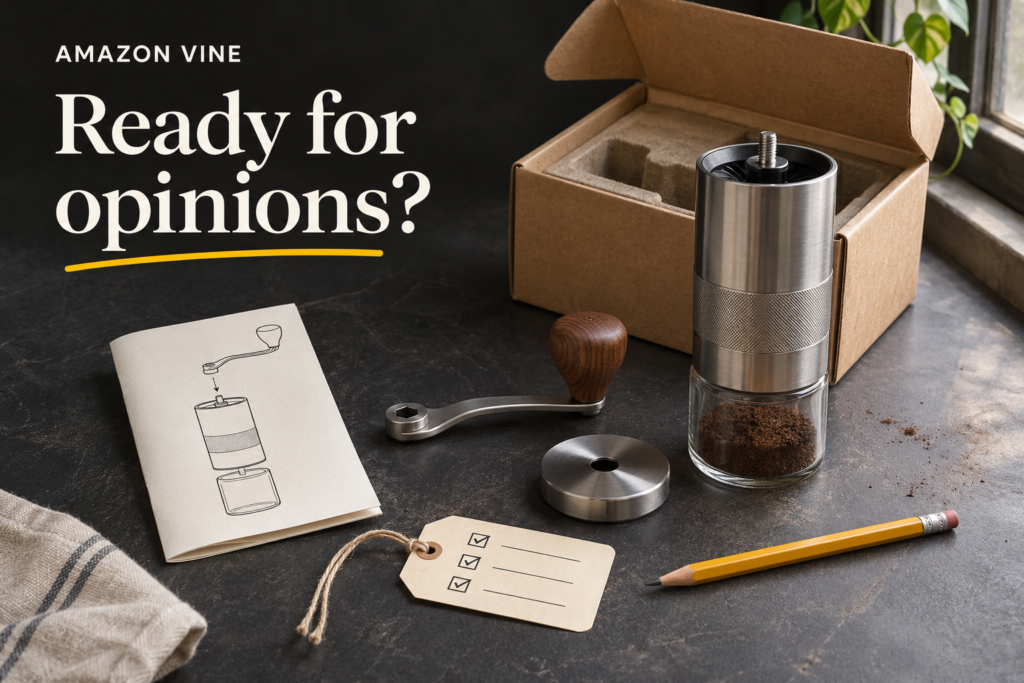
The reviewer does not get your product-development Slack thread. They get the box, the instructions, and whatever the detail page led them to expect. If your new coffee grinder needs a trick to secure the handle, “our team knows how” is not much help to the person opening it.
Before enrolling a product in Amazon Vine, check the exact ASIN’s eligibility, test the complete retail experience, budget for the units and applicable charges, and decide who will act on the feedback. Vine can help an eligible product collect independent reviews. It cannot repair a confusing offer or promise the rating your launch plan needs.
Check the exact ASIN, not just the review count
Where Vine is available, start with the enrollment screen for your selling account and marketplace. Amazon’s public program guide describes FBA listings with fewer than 30 reviews among the product conditions. Account permissions, product restrictions, and the listing’s current state also matter. A low review count is a starting condition, not confirmation that your ASIN can enroll.
Check the parent and child ASINs you are actually submitting. Does the selected product match the physical unit you intend to provide? Are the title, image, description, and product attributes complete and accurate? Read the current eligibility notice rather than assuming a trademark or a working detail page settles every requirement.
If the program flags a brand-role or catalog problem, identify that problem before changing unrelated copy. Support with Brand Registry and catalog issues should begin with the notice, affected ASINs, and evidence behind the case. Repeatedly submitting the same enrollment does little to explain what is wrong.
Run the unopened-box test before giving away a unit
Take a sealed unit from the batch customers will receive. Ask someone unfamiliar with the product to open it and attempt the first use without coaching. Watch where they hesitate. The point is to discover the questions your team has stopped noticing.
- Contents: can the person identify what is included and what must be supplied separately?
- Fit and capacity: do the package, listing, and actual product describe the same dimensions, compatibility, and usable quantity?
- First use: can they assemble, set up, or operate it using the instructions provided?
- Condition: do the parts, finish, seals, and protective packing arrive as intended?
- Claims: can your team substantiate the benefits and limitations the page communicates?
Imagine a manual grinder whose handle will not stay in place. If the locking component is defective, the product needs a correction. If it works but the leaflet omits the locking step, the instructions need work. If shoppers expect a larger grounds container because of the imagery, the offer needs clearer scale. Those problems have different owners.
When the gap is what the page explains, listing copy and images built around buying questions can help set a more accurate expectation. When the product itself fails, a better description cannot make it reliable. Inspect the affected batch and resolve the cause before sending more units into the same experience.
Budget for exposure, not a promised number of reviews
Vine Voices choose products they want to try and provide their own opinions. Available units, claimed units, and published reviews are different numbers. Do not build the business case by dividing the cost by a review count you have assumed will arrive.
For an illustrative budget, suppose making, preparing, and getting one sample unit to fulfillment costs 12 in your working currency. Setting aside ten units commits 120 in those unit costs, before the enrollment fee and any other applicable order or program charges. Replace those inputs with your own costs. A zero enrollment fee would not turn the physical units into free inventory.
Use the fee shown on the current enrollment confirmation and the rules for that marketplace. Also check whether your decision covers one child product or a parent enrollment. Amazon’s fee guidance explains that enrollment-based pricing need not fall merely because fewer units are claimed or fewer reviews appear. Decide what you can spend without assuming a favorable rating or an immediate sales lift.
Keep the stock decision separate from the review target. If providing units would leave too little inventory for normal orders before replenishment, address that constraint first. Enrolling a product and then leaving its offer unavailable makes the launch harder to manage.
Build a feedback loop that can change something
Assign an owner before the first unit is claimed. Track the enrolled ASINs, claimed quantity, published reviews, product batch, and any relevant listing or instruction changes. Record the actual issue in a comment instead of reducing every review to its star rating.
A useful note might read: “The setup step was unclear; compare the supplied leaflet with the current instruction diagram.” Another might say: “The reviewer expected a larger container; check the capacity statement and scale photo.” A preference about color is different from a repeated functional defect. Keep that distinction when choosing what to fix.
A customer-support process that groups recurring product questions helps connect review themes with ordinary buyer messages and return reasons. The output should be a named action for the product, listing, packaging, or operations owner. A folder full of screenshots is not follow-through.
Keep customer care separate from attempts to influence a review. Do not contact Vine Voices to discuss their review, rating, or participation, and do not offer a benefit for changing feedback. Use the permitted Amazon support and reporting paths for the specific issue. A negative opinion alone is not a policy violation, and a support resolution should never depend on a review change.
Choose between enrolling now and fixing first
Vine makes more sense when the exact product is eligible, the customer experience is ready, and your team can afford the allocation and act on what it learns. Waiting is reasonable when the batch is inconsistent, the instructions are incomplete, or the listing leaves an important buying question unanswered.
Before confirming, write down three decisions: which product version is ready, how much exposure you will fund, and who owns the next review of the evidence. Check cancellation and re-enrollment conditions at this point. Amazon’s Vine guidance warns that canceling after a unit has been claimed can prevent re-enrollment; stopping an enrollment also does not prevent a review from arriving for a unit already claimed.
Once feedback appears, look for changes you can verify. Did the next batch include the corrected instructions? Does the detail page now explain the limitation? Are later support contacts still raising the same issue? Sales and conversion can be reviewed alongside those changes, with price, traffic, and availability kept in view. A before-and-after movement alone does not isolate Vine’s effect.
The useful launch question is not how quickly you can fill a review counter. It is whether a stranger can receive this product, understand the promise, and have the experience you intended. Start with the box you are about to send.
If your launch plan has a review target but no owner for the questions a reviewer might raise, that is a useful place to start. AMZEXACT is an Amazon partner and has helped new, small, and large brands connect the product, listing, and account work behind a launch. In a video audit, we can help rank the gaps worth addressing before you commit the next unit.