Ranking at the top of Amazon.in is one of the biggest goals for any Amazon seller. But getting there is not as simple as adding a few high-volume keywords to your title. Your listing quality, product data, pricing, availability, customer response, conversion performance, and advertising strategy all work together. If you want to improve your Amazon India ranking in 2026, focus on making your product easier to find, understand, and buy.
Amazon search is built around one basic objective: helping shoppers find products that are relevant to what they searched for and giving them a strong buying experience.
So, instead of trying to beat the algorithm, build a listing that delivers relevance, clarity, and a strong customer experience.
Here is a practical approach.
1. Start With How Indian Customers Actually Search
Strong Amazon keyword research begins with the customer—not the product catalogue.
A seller may describe a product using technical terminology, while shoppers search using completely different language.
For example, a seller may call a product:
“Orthopaedic Lumbar Support Cushion”
while customers may search:
“back support pillow for chair”
The second phrase may reflect much stronger buying intent.
Start with a broad seed keyword for your product and study the language customers use around it.
Amazon.in autocomplete can be useful because it reveals common search phrases related to your starting term. Customer reviews, competitor listings, search-term reports, advertising data, and category terminology can provide additional keyword ideas.
Amazon India seller guidance also recommends thinking from the customer’s point of view and using relevant search terms rather than simply chasing popular but unrelated keywords.
The objective isn’t to collect the largest possible keyword list. It’s to identify the words that accurately connect your product with the right shopper.
For deeper support with keyword mapping and organic discoverability, explore Amzexact Amazon SEO.
2. Balance Search Volume With Buyer Intent
One of the most common mistakes in Amazon Seller Central optimization is targeting a keyword simply because it has high search volume.
High volume doesn’t automatically mean high value.
Suppose you sell a stainless-steel lunch box.
A broad keyword such as:
“lunch box”
may generate significant searches, but it is also extremely competitive.
A more specific phrase such as:
“stainless steel lunch box for office”
may have less search activity but much stronger purchase intent.
The shopper already knows the material, product type, and use case they want.
A healthy keyword strategy usually combines broad category terms with more specific long-tail phrases.
Your ideal keyword should satisfy four things:
- Accurately describe the product.
- Have meaningful search demand.
- Match buyer intent.
- Give your listing a realistic opportunity to compete.
This is where Amazon SEO India becomes more strategic than simply finding the highest-volume keyword in a tool.
3. Optimize the Product Title for Relevance First
Your Amazon product title is one of the first pieces of information a shopper sees.
Amazon’s current India guidance states that product titles should clearly and concisely describe the key product information, while exact requirements can vary by product type.
That means your title should be written for clarity before keyword density.
A good structure may include:
Brand + Product Type + Important Feature + Size/Quantity + Relevant Differentiator
Avoid forcing every possible keyword into the title.
A title that reads like:
“Lunch Box Steel Lunchbox Office Box Tiffin Stainless Lunch Container Best Lunch Box Men Women Kids”
may contain many keywords but creates a poor customer experience.
A cleaner title could communicate the same product naturally:
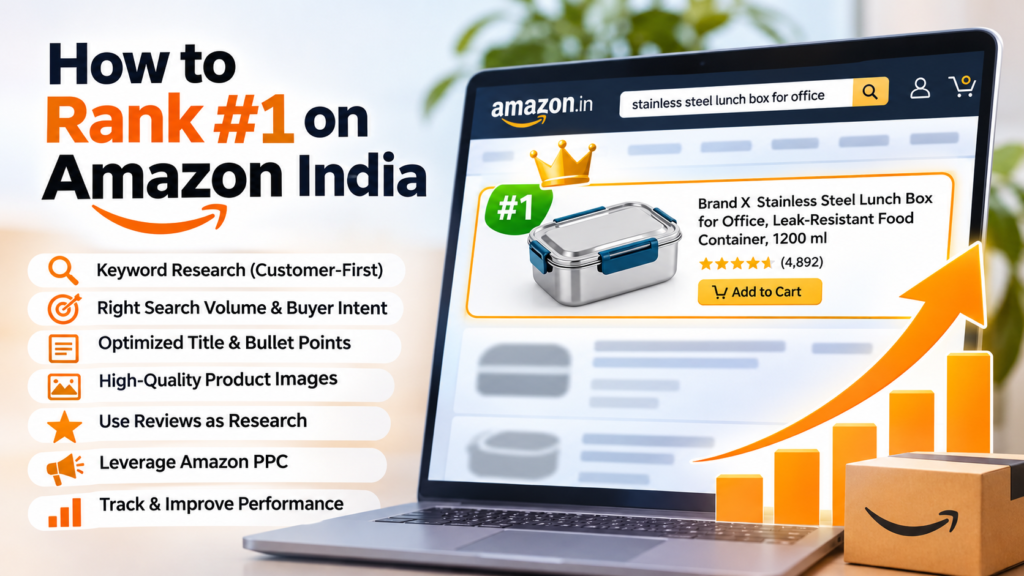
Brand X Stainless Steel Lunch Box for Office, Leak-Resistant Food Container, 1200 ml
Relevant keywords remain present, but the listing is much easier to understand.
For help improving titles, bullet points, attributes, and conversion-focused copy, see Amzexact Product Listing Optimization.
4. Use Bullet Points to Sell, Not Just Rank
Bullet points are often treated as another place to insert keywords. That misses their biggest purpose.
The shopper has already clicked. Now you need to convince them that the product is right for them.
Use bullet points to answer practical buying questions:
- What problem does the product solve?
- Who is it designed for?
- What makes it different?
- What size is it?
- What materials are used?
- What is included?
- Are there compatibility limitations?
Secondary keywords can be integrated naturally while answering those questions.
Amazon seller guidance specifically recommends using bullet points to describe features and benefits while incorporating relevant search terms naturally.
The important word is naturally. If every sentence sounds as though it was written for a search engine instead of a human shopper, you’ve probably gone too far.
5. Don’t Waste Your Backend Search Terms
Backend or generic search terms are useful for relevant keywords that do not fit naturally into the visible listing.
This can include:
- Synonyms.
- Alternative product names.
- Spelling variations.
- Abbreviations.
- Other genuine ways shoppers may describe the product.
Amazon recommends avoiding unnecessary repetition, irrelevant terms, punctuation-heavy formatting, competitor brand names, and words already adequately represented in the listing.
Use this space carefully. Don’t treat backend keywords as a dumping ground for every phrase exported from your keyword tool.
Relevance still matters.
And because Amazon can update field limits and category requirements, always check the current limit shown inside your Amazon Seller Central India listing editor rather than relying on an old blog post.
6. Your Images Can Affect Ranking Indirectly Through Conversion
Amazon SEO doesn’t end with text.
Imagine two products appearing beside each other in Amazon.in search results. Both are relevant. Both have similar prices.
One has a tiny, unclear main image. The other has a large, clean, professional image that immediately explains the product.
Which listing is more likely to earn the click?
Once customers arrive on the detail page, secondary images should answer questions about:
- Product dimensions.
- Materials and construction.
- Key benefits and features.
- Product usage.
- Compatibility.
- Package contents.
Amazon India encourages sellers to provide high-quality images and complete product information to improve listing quality.
Better images can improve shopper confidence and conversion. And a listing that consistently attracts the right shoppers and converts effectively is in a far stronger position than a listing that simply contains more keywords.
7. Use Customer Reviews as Research
Reviews are valuable, but not because sellers should try to make customers insert target keywords into them.
That is the wrong approach.
Instead, use reviews as Voice of the Customer research.
Study your own reviews and competing products.
Customers may repeatedly say things like:
- “Easy to clean”
- “Too small for office”
- “Fits perfectly in my car”
- “Lid leaks”
- “Good for travelling”
Those phrases tell you what buyers actually care about.
They can influence your:
- Product development.
- Listing images.
- Bullet points.
- A+ Content.
- FAQs.
- Advertising messages.
- Keyword research.
The goal is to understand customer language—not manipulate customer reviews.
8. Amazon PPC Can Help You Discover Winning Search Terms
Organic ranking and Amazon advertising shouldn’t operate independently.
Sponsored Products campaigns can generate valuable search-term data.
You may discover that a keyword you expected to perform well gets plenty of clicks but very few purchases. Another long-tail term may receive less traffic but convert significantly better.
That information can feed directly back into your Amazon listing optimization and SEO strategy.
For example, a converting PPC search term may deserve greater visibility in your title, bullet points, A+ Content, or product imagery—provided it accurately describes the product.
At the same time, advertising can help products gain visibility while organic rankings are still developing.
Amazon’s own seller guidance recommends Sponsored Products as one way to improve visibility while sellers work on organic discoverability.
For support connecting paid search with organic performance, explore Amzexact Amazon PPC Management.
9. Check the Things Keywords Cannot Fix
Sometimes a seller keeps changing keywords even though keywords aren’t the real problem.
Your product may struggle to rank because:
- The listing is suppressed.
- Inventory is unavailable.
- The product sits in the wrong category.
- Important attributes are missing.
- The offer is uncompetitive.
- Customers simply aren’t converting.
Amazon India seller guidance specifically recommends checking active status, stock availability, category placement, listing quality, and search-term setup when products aren’t appearing correctly in search.
This is why ranking work should begin with diagnosis.
Before rewriting the entire listing, ask:
Is this actually an SEO problem?
At Amzexact Full-Service Amazon Management, we look at listings, advertising, availability, catalog health, and account performance together because a ranking problem can come from several parts of the account—not only keywords.
10. Measure Progress Instead of Chasing “#1”
No ethical Amazon SEO agency can guarantee that an ASIN will permanently rank #1 for a competitive keyword.
Amazon controls search placement, competitors keep changing, and shopper behaviour moves over time.
A more useful objective is measurable improvement.
Track whether your priority keywords are moving upward.
- Watch sessions and impressions.
- Review conversion rate.
- Monitor organic and sponsored traffic.
- Check whether the right search terms are producing orders.
- Compare performance before and after meaningful listing changes.
Sometimes moving from page four to page one is transformational even if you never hold the number-one position.
The goal should be profitable visibility, not a screenshot of one ranking position.
Final Takeaway
Ranking higher on Amazon India isn’t about finding a secret algorithm trick. It comes from connecting the fundamentals.
- Understand how customers search.
- Choose relevant, high-intent keywords.
- Build a clear product title.
- Use bullet points to answer buyer questions.
- Use backend search terms efficiently.
- Improve images and product information.
- Learn from customer feedback.
- Use Amazon PPC search-term data.
- Keep inventory and catalog health in order.
- Measure what changes.
Amazon keyword research should never be a one-time launch task. Search behaviour changes, competitors enter the market, demand shifts, and your own advertising data continues to reveal new opportunities.
The strongest Amazon India sellers keep learning from those signals and adjusting their listings accordingly.
If you want help improving Amazon SEO, product listing optimization, Amazon PPC, keyword research, and complete Amazon Seller Central performance, visit Amzexact.
Better ranking starts with better relevance. Better sales come when relevance and conversion work together.